Skip to product information
1 of 6

NWC Naturals

Tri-KRILL™ For Pets Pump - Buy 3 Get 1 FREE!

Tri-KRILL™ For Pets Pump - Buy 3 Get 1 FREE!

Regular price $140.97 USD
Regular price $216.19 USD Sale price $140.97 USD
Sale Sold out
Shipping calculated at checkout.

Tri-KRILL ™ Pump For Pets: Buy 3 Get 1 FREE Discount Pack
  • Powerful Antioxidant Formula
  • Supports Your Pet’s Immune System
  • Easy to use pump with no fishy breath
  • Recommended for joint support, supporting normal flexibility

Product Description

Tri-KRILL™ Pump For Pets

krill oil for dogs

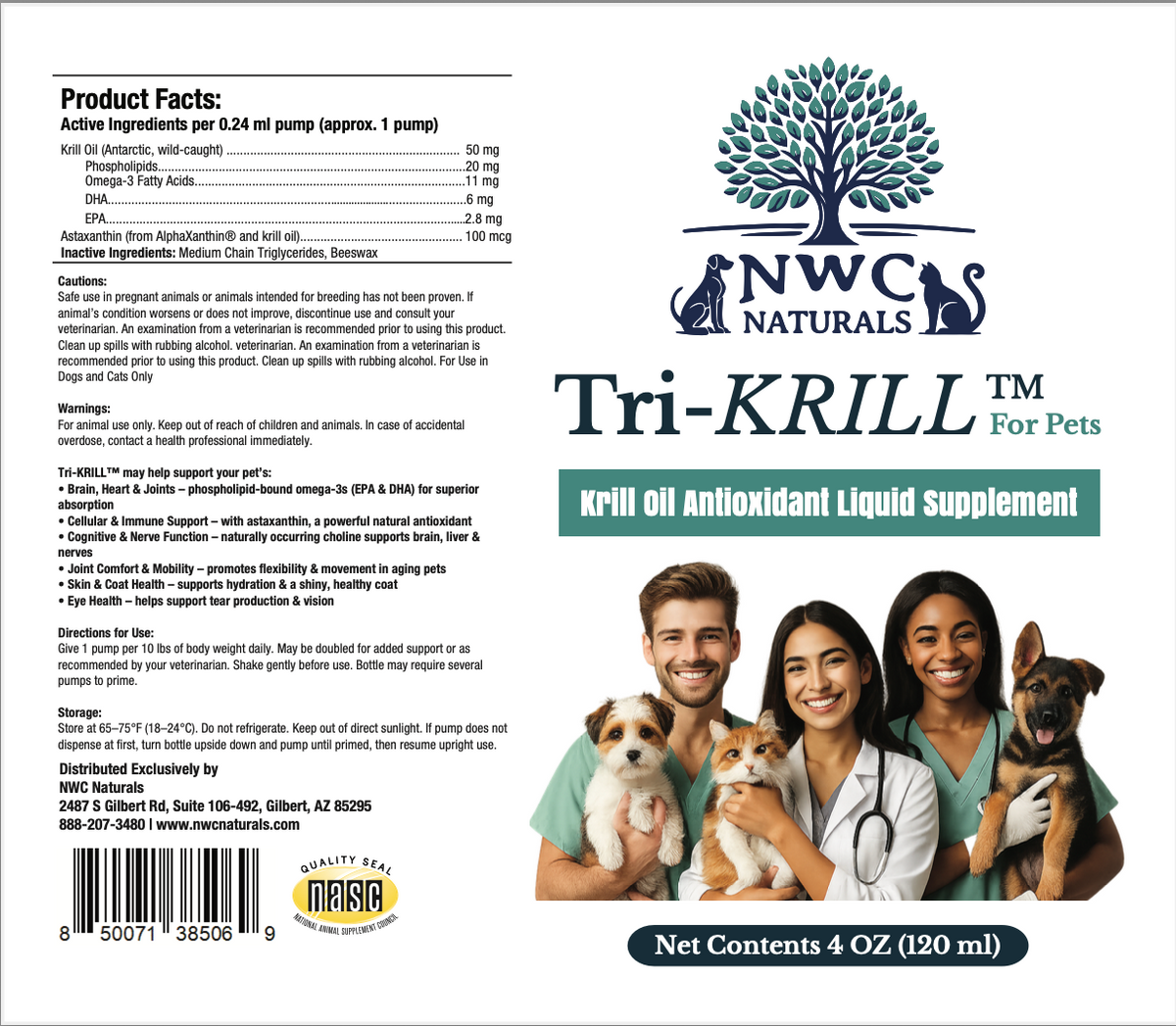
Tri- KRILL™ Pump For Pets contains 500 pumps per bottle. Use one pump for every 10 pounds of body weight per day, thats a 250 Day supply for a 20 pound pet.
Tri- KRILL™ contains more astaxanthin per serving than any other plain krill oil product on the market.

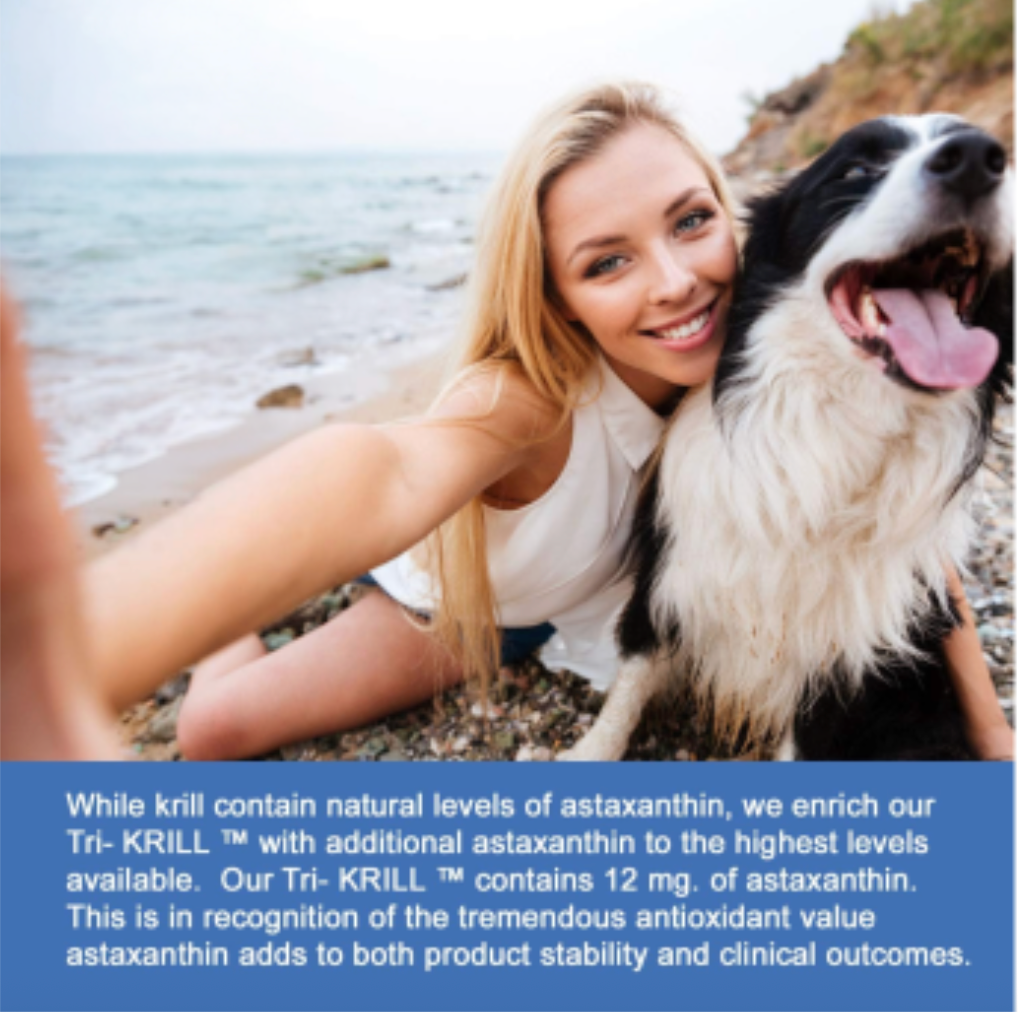
Tri-KRILL™ is sourced directly from the Antarctic which combines the power of Krill Phospholipids with 7X astaxanthin per serving in an easy-to-use pump.We add genuine AstaREAL® astaxanthin to enhance the naturally occurring astaxanthin that krill oil contains twenty times stronger, the highest level in any krill pump.

Key Benefits

  • Wild Caught Antarctic Krill Oilkrill oil for dogs
  • Powerful Antioxidant Formula
  • Natural Antioxidant Astaxanthin
  • Fights Free Radicals
  • Supports Your Pet’s Immune System
  • Eight Months’ Supply For 20-Pound Pet
  • Airless Pump For Better Shelf Life
  • Natural Krill Taste That Pets Love
  • 100% Genuine AsaREAL® Astaxanthin

Benefits of Astaxanthin

  • Paw printPhysical Endurance and Muscle Recovery
  • Paw printSupports Good Eye Function
  • Paw printSupports Good Skin Health
  • Paw printImmune Response

Benefits of Tri-Krill™

  • Paw printHealthy immune system and joint support
  • Paw printKrill oil contains Choline which is found in krill phospholipids as part of the Phosphatidyl choline molecule. Choline is not found in fish triglycerides. Choline has critical functions as a precursor to the neurotransmitter acetylcholine.

Why Tri-KRILL™?

Why is it so important to supplement my pet’s diet with Omega 3 fatty acids?

Today, our pets are receiving more Omega 6 fatty acids in their diets than necessary. The cattle meat used in most pet foods contains an unnecessary amount of Omega 6 fatty acids because the cattle are now being fed grains instead of grass.

Too many Omega 6 fatty acids can cause many problems in your pets. Supplementing our pets’ diets with Omega 3 fatty acids will help to normalize this imbalance.

Krill Oil absorbs quickly into the system, providing benefits such as agility, suporint healhty joints and can help maintain a healthy heart, brain and nervous system, skin and coat.

Krill Oil vs. Fish Oil

  • Dog Krill oilKrill oil contains a higher concentration of Omega 3 fatty acids, and also contains Astaxanthin, which is an added nutritional benefit.
  • Dog Krill oilIt does not contain mercury and therefore there is no added risk of heavy metal poisoning.
  • Dog Krill oilIn addition, Krill Oil contains highly bioavailable EPA and DHA which can aid in cognitive function, and support healthy joints.
  • Dog Krill oilKrill Oil is FOUR times more potent than Fish Oil and therefore has four times the benefit!
  • Dog Krill oilBecause of the Astaxanthin in krill oil; this puts it to the top of the list of all omega-3 fatty acids sources.

What Is Astaxanthin?

Krill oil contains high levels of one of the most powerful natural antioxidants called Astaxanthin. Astaxanthin is a carotenoid molecule from the same family as beta-carotene, lycopene, and zeaxanthin, though astaxanthin appears to be more active in quenching superoxide, hydroxyl, and other radical species.

Astaxanthins is what gives salmon its red color. Krill get their astaxanthin from small phytoplankton, their primary source of food. While krill contain natural levels of astaxanthin, we provide additional astaxanthin to our omega-3 krill phospholipid products.

Krill oil contains omega-3 fatty acids, which is the main reason it's a popular nutritional supplement.

Krill oil is contains an antioxidant called astaxanthin. The algae that krill eat produce the bright red pigment astaxanthin that gives krill and other crustaceans such as lobster and shrimp their reddish-pink color.

Unlike fish oil, krill oil doesn't cause fishy breath. Also, krill oil contains higher amounts of astaxanthin than fish oil.

Storage and Handling

Store at room temperature 65 degrees to 75 degrees. Do not refrigerate. At first the

bottle may need a few pumps to prime. If it does not start flow right away, turn upside

down and pump until primed, then pump upright normally.

Side Effects

Side Effects;Pets with allergies to seafood shouldn't use krill oil.

More information

What Is Astaxanthin?
Tri-Krill™ contains high levels of one of the most powerful natural antioxidants called Astaxanthin. Astaxanthin is a carotenoid molecule from the same family as beta-carotene, lycopene, and zeaxanthin, though astaxanthin appears to be more active in quenching superoxide, hydroxyl, and other radical species.
Astaxanthins is what gives salmon its red color. Krill get their astaxanthin from small phytoplankton, their primary source of food. While krill contain natural levels of astaxanthin, we provide additional astaxanthin to our omega-3 krill phospholipid products.

What are Krill and where do they come from?
Krill is the common name given to the Euphausiacea of shrimp-like marine crustaceans. Also known as euphausiids, these small invertebrates are found in all oceans of the world. The common name Krill comes from the Norwegian word krill, meaning "young fry of fish", which is also often attributed to other species of fish. Krill are found in all oceans of the world but harvested from the Antarctic waters and Southern Oceans.


These small crustaceans fuel the oceans of the world. Krill feed on phytoplankton, microscopic, single-celled plants that drift near the ocean’s surface and live off carbon dioxide and the sun’s rays. They feed hundreds of animals from fish, birds and whales. Antarctic krill are among the largest of the 85 known krill speciesand can live up to 10 years.


Krill oil contains omega-3 fatty acids, which is the main reason it's a popular nutritional supplement.
Krill oil is contains an antioxidant called astaxanthin. The algae that krill eat produce the bright red pigment astaxanthin that gives krill and other crustaceans such as lobster and shrimp their reddish-pink color.
Unlike fish oil, krill oil doesn't cause fishy burps or an after taste. Also, krill oil contains higher amounts of astaxanthin than fish oil.

How to use?

Directions

Directions:

Give one measured pump for every 10 pounds of your pet’s body weight every day. This may be doubled for added support or on the advice of your veterinarian.


Side Effects:
Pets with allergies to seafood shouldn't use krill oil.

Product Label

Supplement Facts

Tri-KRILL™ For Pets Pump - Buy 3 Get 1 FREE! — Supplement Facts

Videos

Reviews

(3)
View full details

Certified from Source to Shelf

Our whole-food, enzyme-activated formulas are made in a U.S. GMP facility and verified by third-party labs. We use human-grade ingredients, transparent labels, and our L.E.A.D.S.® delivery system to maximize absorption—no fillers, no artificial colors, gluten, or dairy.

  • GMP-Certified (USA) — Manufactured in audited, cGMP facilities
  • NASC Certified — Member of the National Animal Supplement Council quality program with standards for labeling, GMPs, lot tracking, and adverse-event reporting.
  • L.E.A.D.S.® Delivery — Enzyme-mineral transport for better uptake
  • Third-Party Tested — Microbials, heavy metals & purity confirmed
  • Human-Grade Ingredients — Pet formulas meet AAFCO guidance
  • Non-GMO • No Fillers — Gluten & dairy free; no artificial additives
  • CFU-Verified Probiotics — Clinically informed strains, dose on label = dose in bottle
  • 16+ Digestive Enzymes — Broad-spectrum support in key products
  • Veterinarian & Naturopath Formulated — Real-world dosing, practical results